
Run your entire layer farm from one source of truth.
Flocks, daily production, feed manufacturing, inventory, health and a full double-entry ledger, all in one system. The numbers your accountant signs off are the very same numbers your farm hand logged at the coop door that morning.
Purpose-built for commercial layer operations · books built to IAS 41 & IAS 21
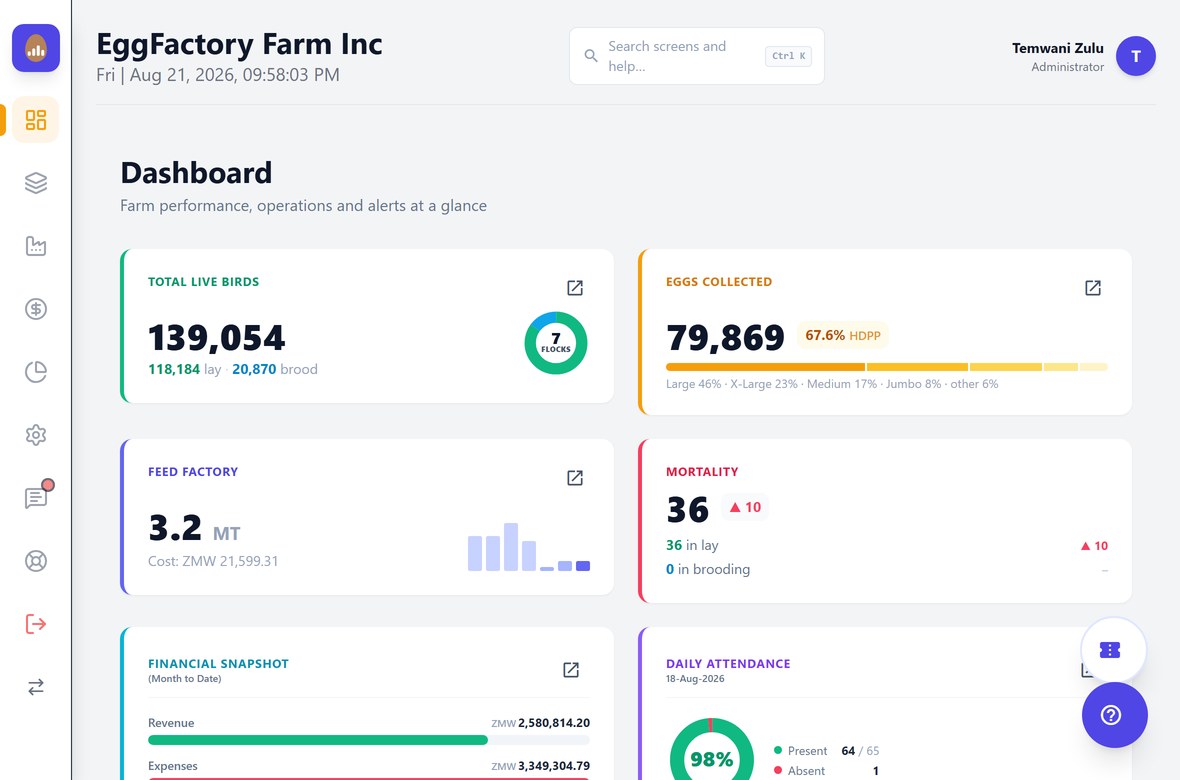
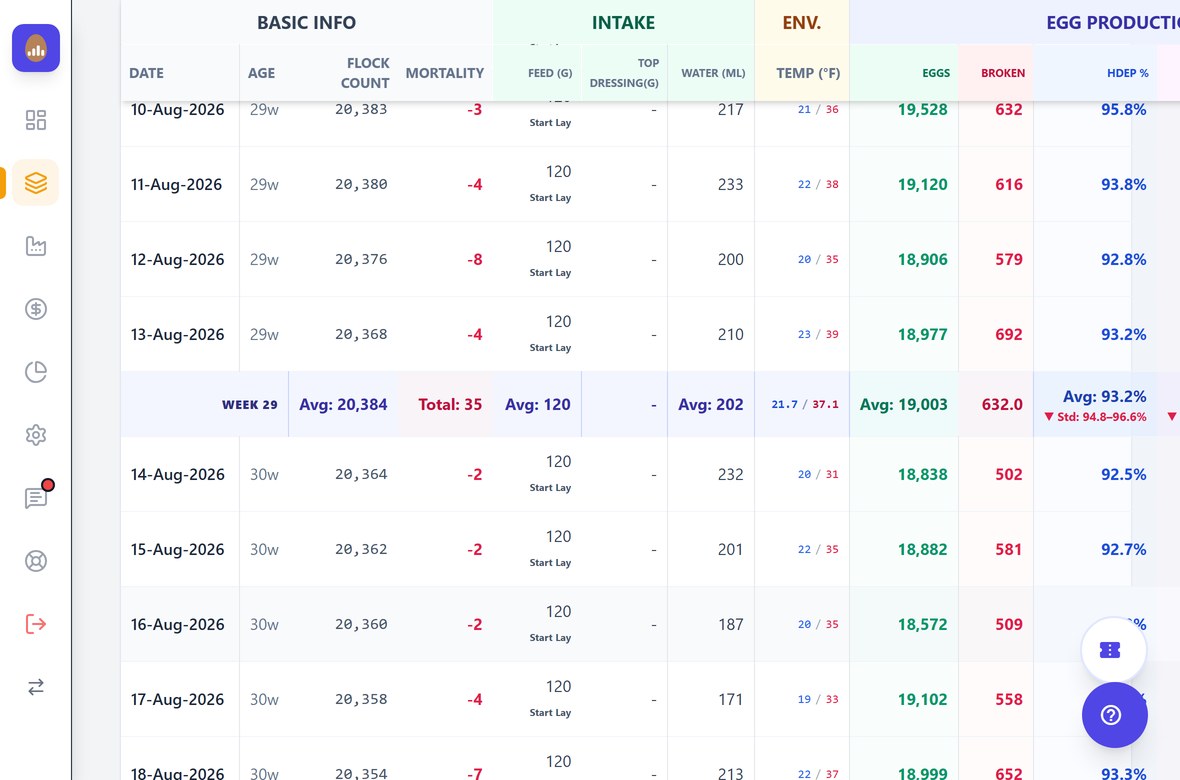
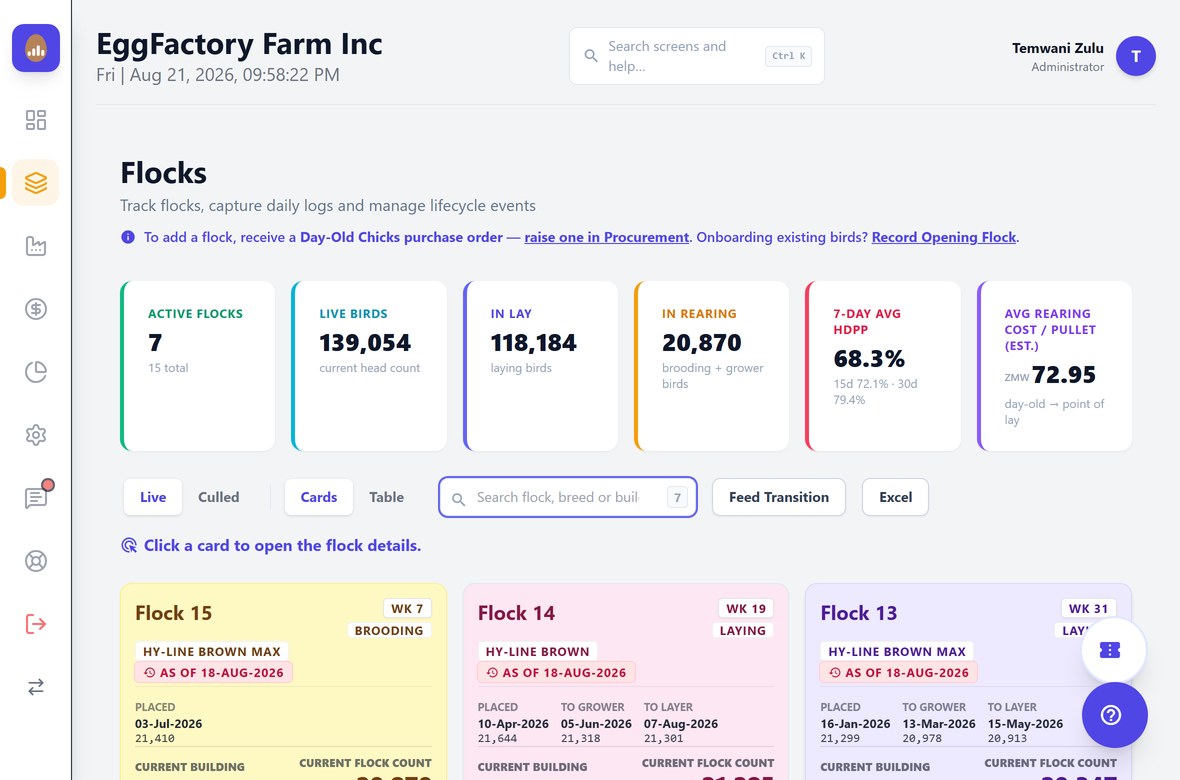
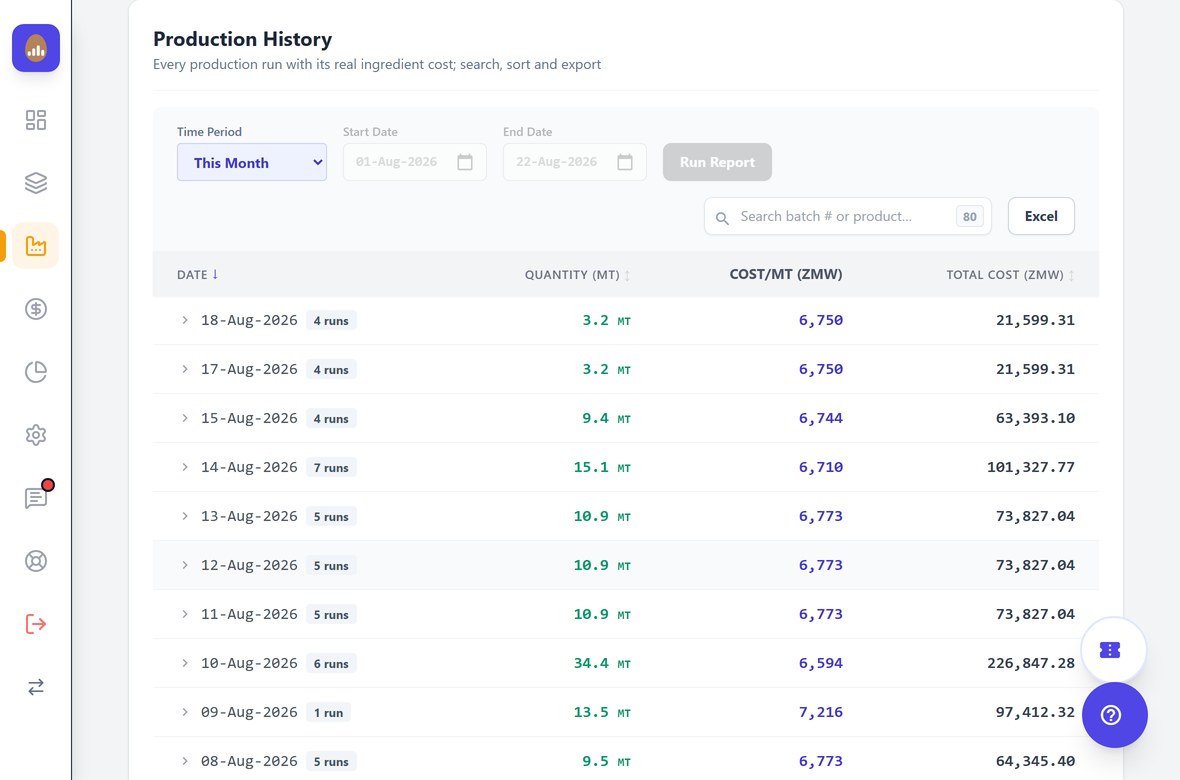
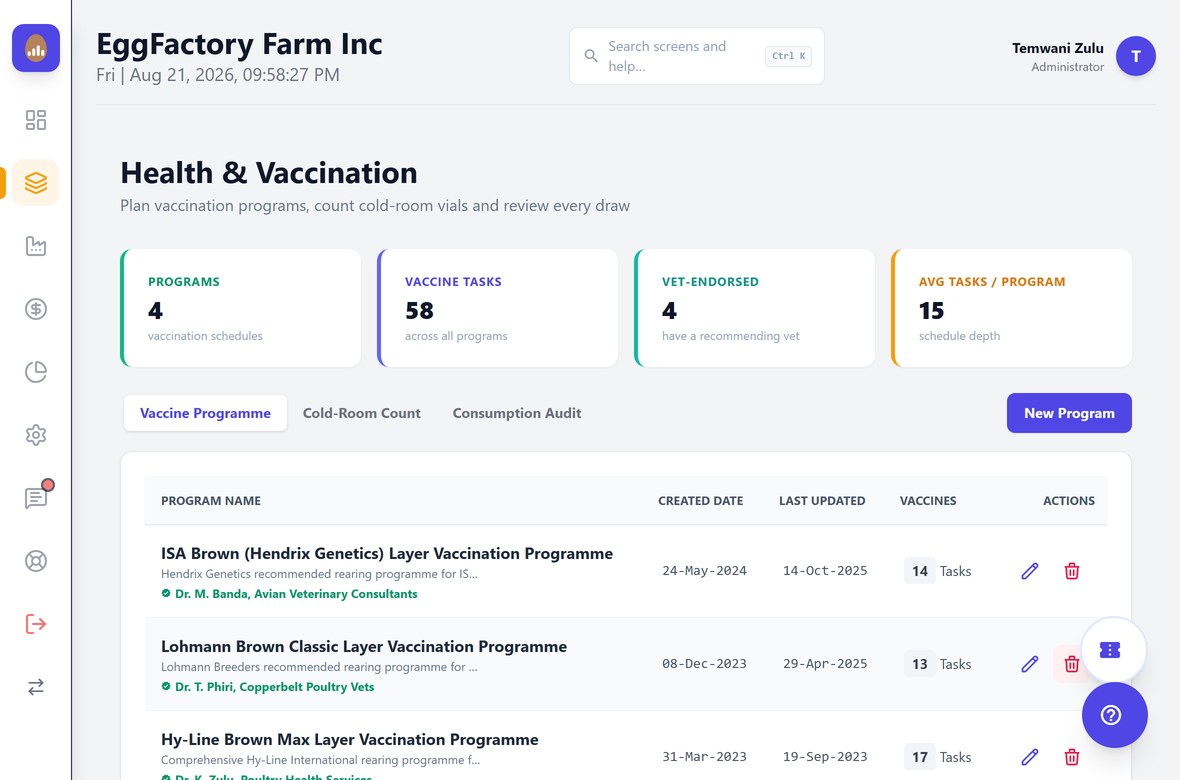
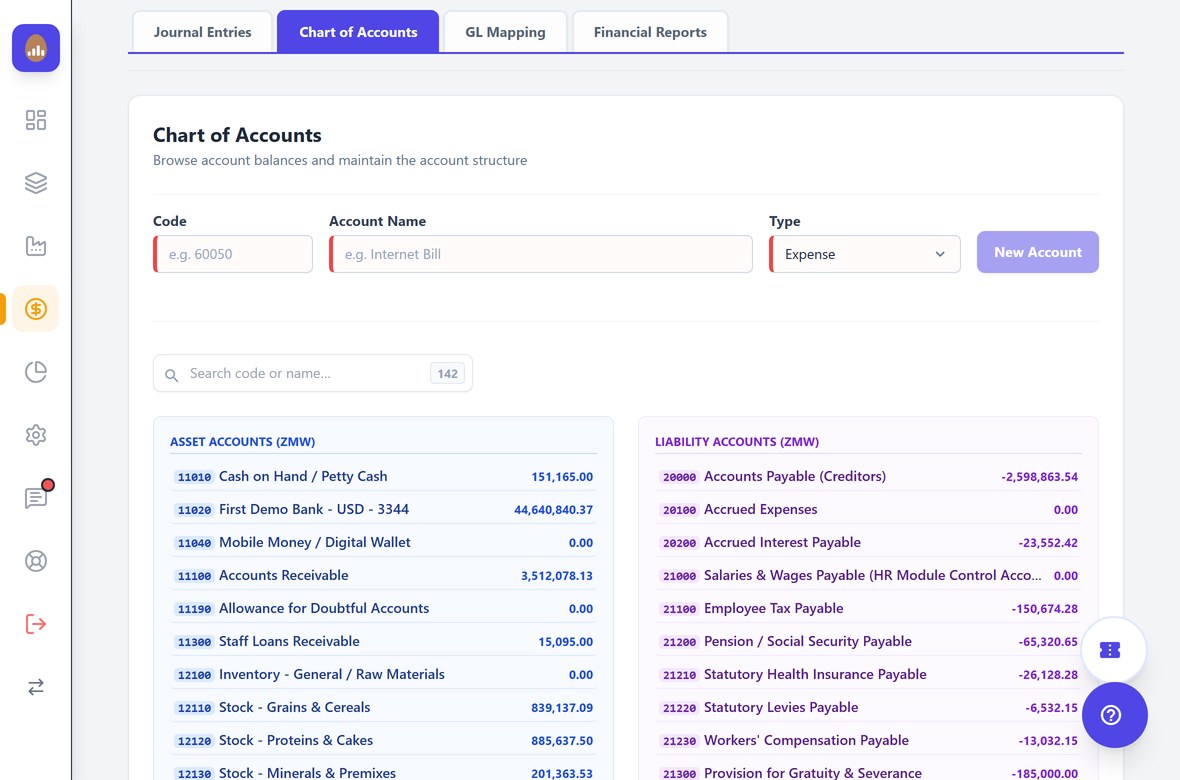
Every screen here is the real product, captured from one demo farm built from a working layer operation’s own anonymized records.
One platform. Four jobs done well.
Every role on a commercial farm sees the same live data, shaped for their work.
Know your real position, live
Feed-and-egg margin per flock, fleet and building asset registers, cash and payables. Operational postings land the moment work is logged; depreciation posts monthly.
- Dashboard KPIs: birds, eggs, feed cost, mortality trend
- Profit & loss · balance sheet · general ledger · monthly cash in and out
- Anti-manipulation safeguards on stock & flock counts
Run the day from one screen
One daily log per flock captures eggs by grade, feed, water, temperature and mortality. Every downstream number follows from it automatically.
- Hen-day production % with 7/15/30-day trends
- Low-stock alerts ranked by run-out against lead time
- Feed factory runs, staff attendance, task calendar
Programs, not paperwork
Vaccination templates generate every task per flock by age. Log completions with batch numbers and costs, fully traceable at audit.
- Vaccination scheduling from hatch date
- Mortality split by cause & lifecycle stage
- Medication stock with expiry-tracked batches
Books that audit clean
Every action that moves money or stock posts its own balanced journal entry as it happens, and it balances by construction, because an unbalanced set is refused. Biological assets are posted to IAS 41 mechanics and foreign currency to IAS 21, automatically.
- Double-entry ledger, chart of accounts, GL mapping
- Bio-asset capitalization, amortization & disposal
- Multi-currency invoices, realized/unrealized FX
Everything a layer operation needs.
Eighteen capabilities sharing one database. No exports, no re-typing, and no arguments about whose figure is the right one.
Flock Lifecycle
Placement to depopulation: brooding, growing, lay and cull, with per-flock economics down to the rearing cost of a single pullet.
Egg Production
Daily collection by grade, hen-day production %, and automatic egg inventory into sellable, batch-tracked stock.
Feed Factory
Recipes, production runs, ingredient consumption at weighted cost and finished-feed batches, with output analytics for every day you produce.
Batch-Tracked Inventory
Every delivery creates a batch, and an issue drains the oldest batch first unless the handler names the lot that actually left. Usage & loss recording with mapped GL postings.
Procurement
Purchase orders with landed costs (freight, duty, tax), goods receipt, vendor bills, and payment tracking.
Health & Vaccination
Program templates by bird age, task scheduling, completion logging with vaccine batch traceability and dose-variance flagging.
Accounting
Full double-entry GL, AR/AP with aging, statements, P&L, balance sheet, and the IAS 41/21 mechanics built in.
Fleet & Equipment
Asset register with depreciation, usage logs, service schedules and compliance renewals, right down to the generator.
Buildings
Houses and infrastructure as capitalized assets: occupancy, inspections, maintenance logs, and depreciation.
Human Capital
Employee registry, departments, daily attendance with rate tracking, and role-based system access.
Reports & Exports
Operational and financial reports, one-click Excel export on the main record lists, and print-ready PDF documents.
Payroll
Salaried, daily and hourly staff on one run: attendance-driven pay, statutory deductions, loans and fines recovered under one capped ceiling, and payslips stamped ORIGINAL once and DUPLICATE ever after.
Leave & Settlements
A leave balance that is a ledger rather than a number somebody typed in: accrued, taken, carried and paid out, each with a date and a reason. A leaver’s final settlement is built from it.
Field Mode
A phone-shaped app for the people in the sheds: log a house, close out a health task, clock in, receive a delivery at the gate. Thirteen screens, no desktop chrome, built for one hand. A connection is required, and the app says so the moment it drops.
Scale Integration
BAT1 weighings arrive through VEIT’s own BAT Link desktop bridge, as records rather than a spreadsheet somebody retypes. A fixed BAT2 Connect is built to post to us by itself over HTTPS, with no PC in the shed and nobody remembering to press Send. It is implemented against VEIT’s published protocol and awaiting its first physical scale.
Heat Warnings
Tomorrow’s outdoor forecast, projected through the offset each house has actually measured against it. The building whose ventilation is not coping gets named the day before, not the day after.
Built-in Help Center
Twenty-six guides and nearly seven hundred answered questions, built for farms spread across time zones where a ticket raised at 06:00 may wait a day. The manual is in the app.
Multi-Tenant Security
Row-level isolation per farm, role-based access control, single-session enforcement, and owner super-password gates.
Every corner of the operation.
Real screens, real figures, from one demo farm, built from a working layer operation’s own historical records and anonymized, captured on a single day. From the log a stockman fills in at the shed door to the pay run, the purchase ledger and the depreciation on the houses those birds live in.
Human Capital
Every person on the farm, their department, reporting line and daily attendance.
Payroll
Salaried, daily and hourly staff in one run, with payslips locked once paid.
Inventory
Every item, its category, its stock on hand and what it is worth.
Stock Usage
The full history of one item: what came in, what went out, and what is left.
Procurement
Purchase orders from raising to receipt to the bill being paid.
Fleet & Equipment
Vehicles and machinery as depreciating assets, with services and renewals tracked.
Buildings
Houses and structures as capitalized assets, with capacity and occupancy.
Daily Log Entry
What the person in the shed actually fills in, once a day, per flock.
Help Center
Twenty-six guides and nearly seven hundred answers, inside the app rather than in a PDF.
Support Tickets
Raise a ticket from the screen you are on; it carries that screen with it.
An assistant built to read your farm every morning.
There is nothing to ask it and no prompt to write. It works through what your team logged, separates what genuinely changed from what only looks different, and puts the few things worth walking out to behind one button, while there is still enough of the day left to act on them. It runs on our own AI service, so we switch it on farm by farm on request rather than by default.
The morning briefing
One short note behind one button: what moved since yesterday, what is running low, and which flocks want looking at. Read it with your first cup and you have done the rounds before you leave the office.
Flock watch
Compares each flock against its own trailing week and its breed standard, across feed, water, lay percentage, mortality and house temperature. It raises the flocks that have genuinely moved, worst first.
Reorder drafts
Watches how fast you are actually burning each ingredient against its lead time, and drafts the purchase orders before you run out. You approve or bin them; it never orders anything on its own.
Your farm’s data works for your farm alone. The assistant reads your records to build a picture of your operation and puts that picture in front of you and nobody else. Your figures stay inside your organization: they are never shown to another farm, never pooled into a benchmark, and nothing in EggFactory trains a model on them. Every insight it produces is drawn from your farm and belongs to it.
Everyone sees their job. Nobody sees more.
A spreadsheet shows everything to everyone who opens it. EggFactory gives each person a role, and the role decides what they can see and what they can enter, enforced by the server itself, not by hiding menu buttons.
Eleven roles, ready to use
Admin, Manager, Feed Factory Manager, Accountant, HR Manager, Vet, Nutritionist, Brooding and Layer Managers, Poultryman, Consultant. Each has sensible access out of the box. A poultryman logs eggs and feed; the ledger and the payroll are simply not there for them, on screen or by URL.
Tune it to your farm
Your own Admin adjusts the matrix: grant a trusted supervisor the stock reports, keep the books to the accountant. Only your changes are stored, so improvements we ship still reach you. And the system will not let a farm lock itself out of its own administration.
Scoped to the shed
A Brooding Manager works every brooding house, a Layer Manager every laying house, automatically. A poultryman can be confined to the houses they actually work, so their entries land where they belong and nowhere else.
The table is not an illustration. It is the shipped default for four of the eleven roles, read out of the permission model the server enforces: thirty-two permissions across seventeen areas, fifteen of them a separate view and edit, and two (the dashboard, and a person’s own password) view only.
Read the bottom row twice. The Farm Manager runs the farm and cannot open the Finance Center at all, and only watches payroll rather than running it. That is separation of duties, shipped as the default rather than left for you to remember.
- A consultant starts with almost nothing. Two permissions: the dashboard and their own password. Everything else arrives only as scopes your farm grants, and a scope grants view. Consultants advise, they do not operate.
- Enforced on the server, not by hiding buttons. A URL typed by hand meets the same rule the menu does.
- You cannot lock yourself out. Your admin can retune any role, but the permission to manage people is a floor the system refuses to remove.
- One farm cannot read another. The separation is built into the database itself rather than the software on top of it, so your records stay yours even if the application ever asks the wrong question.
- Nobody at EggFactory can change your data. Every tenant business endpoint refuses a platform session’s writes, and that restriction is enforced in the database itself, not only in the application.
| Area | Farm Manager | Accountant | Vet | Poultryman |
|---|---|---|---|---|
| Flocks | edit | view | view | view |
| Inventory | edit | view | view | view |
| Feed Factory | edit | none | none | edit |
| Health & Vet | edit | none | edit | view |
| Procurement | edit | view | none | view |
| Human Capital | edit | view | none | none |
| Payroll & Taxes | view | edit | none | none |
| Finance Center | none | edit | none | none |
Bring a running farm in as it stands.
EggFactory was built for farms that are already running, so you never start from an empty screen.
Bring your farm in as it stands
Opening Flocks recognize your existing birds at fair value; Opening Quantities load current stock as traceable batches; opening bank balances post in any currency.
Capture the day, once
Workers log eggs, feed, water, and mortality at the source. Vets complete scheduled tasks. Stores receive POs. Each entry posts its own accounting.
Decide with live numbers
Owners watch feed-and-egg margin per flock and cash in real time; accountants close months on books that were never out of sync with operations.
Your birds are assets. We account for them that way.
Under IAS 41, layers are biological assets whose value changes as they grow, lay, and are culled. EggFactory posts every stage for you: capitalization during rearing, transfer at point of lay, amortization across the laying cycle, and derecognition at cull.
- Every mortality writes off its pro-rata bird value, so no phantom assets linger
- Cull proceeds settle against book value with gain/loss posted
- Multi-currency: both amounts on every journal, realized & unrealized FX (IAS 21)
From delivery truck to egg tray, every batch has a story.
Every stock movement creates or consumes a batch: purchases, production runs, egg collections, even cull harvests. When an auditor, buyer, or vet asks “where did this come from?”, the answer is one click.
- Expiry and withdrawal-period tracking on medical stock
- Issues draw from the oldest batch first, unless the storeman names the lot he opened
- Stock can’t be conjured: flocks require received purchase orders
One plan. It grows or shrinks with your bird count.
$99 a month includes your first 10,000 birds, and it is one cent per bird per month above that, published up to 100,000 birds. No per-user charges, no feature tiers, and no negotiation to unlock the feature you need. Every farm gets the whole system.
Billed in US dollars, in arrears, payable within 14 days. You are charged on the average of daily bird counts across the month, never a peak and never a snapshot taken on billing day. Depopulate part-way through the month and that month’s bill falls with it.
You pay for birds that are alive. You get everything else.
Every night, at midnight on your farm’s clock, EggFactory counts the live birds in your active flocks. Your month is billed on the average of those nightly counts, never the peak, never the number you placed, and never the capacity of your houses. Every farm gets the whole system regardless: the price follows your living birds, never the features you are allowed to use.
A bird that dies stops being billed the same night
Mortality and culls come off the live count as they are recorded. You are never charged for a bird that is no longer in the house, and never asked to pay for the gap between what you placed and what survived.
An empty house costs you nothing
Between crops, while houses sit cleaned and waiting, there are no birds to count, so those days cost you almost nothing. Cleaning and repair time is expensive enough without software billing you through it.
Depopulate mid-month and this month’s bill falls
Because it is an average of the days, not a reading taken on billing day, a flock that leaves on the 10th is only counted for ten days. You cannot be caught out by when in the month you happen to clear a house.
Every farm gets every feature
There is no Starter that hides the accounting, no Pro that unlocks the reports, and nobody to ring about an upgrade. A thousand-bird farm and a two-hundred-thousand-bird farm run the identical system. The only thing that changes with size is the number of living birds you are billed for.
A changeover month, worked out
20,000 birds depopulated on the 10th, houses cleaned, the new crop placed on the 25th.
| Days 1 to 10 | 20,000 birds | 200,000 bird-days |
| Days 11 to 24, houses empty | 0 birds | 0 |
| Days 25 to 31, new crop | 20,000 birds | 140,000 bird-days |
| Average across the month | 10,968 birds | 340,000 ÷ 31 |
Same farm, same month, same birds. The difference is only when the software decided to count.
What that actually costs
| Average live birds | Monthly total | How it is worked out |
|---|---|---|
| 5,000 | $99 | Under the included 10,000 |
| 10,000 | $99 | Exactly the included amount |
| 20,000 | $199 | $99 + 10,000 × $0.01 |
| 50,000 | $499 | $99 + 40,000 × $0.01 |
| 100,000 | $999 | $99 + 90,000 × $0.01 |
| Over 100,000 | Let’s talk | The published rate runs to 100,000 birds. Past that we agree it with you. Same whole system, no feature tiers. |
How farm software usually charges, and why we don’t
These are the shapes farm software is usually sold in, and here is an example of what each one does on the day a house stands empty.
| The usual model | What you are really paying for | On a changeover month |
|---|---|---|
| “Contact us for a quote” | Whatever the salesperson decides your farm can bear. You cannot compare it against anything, because nobody else publishes theirs either. | Unknowable until you are already in a conversation |
| Animal tiers | A band, not a number. Your live count decides which flat plan you sit in; the bill does not move when birds die, only when you cross a line. | Unchanged. You pay the band you sit in |
| Declared herd size | A figure the farm states, often an annual average agreed at renewal. If your flock shrinks, the published remedy is to contact support before you renew. You have to ask in order to pay less. | Unchanged until you raise it yourself |
| EggFactory | The birds that were alive last night, averaged across the month, counted by the system rather than declared by you. | Falls, automatically, the day the house empties |
The price is on the page
Almost every serious poultry platform we could find, and every general farm ERP, publishes no price at all. You book a demo to learn what it costs. Ours is above, in full, with the arithmetic.
A bill that falls without you asking
Where software counts animals at all, the count usually moves a tier boundary rather than the bill, or it is a figure you declare and then have to ask to revise. We could not find one that simply charges less, by itself, because fewer birds are alive this month.
No edition, no upsell, no call
Every farm runs the whole system. There is no plan that withholds the accounting, no add-on for the reports, and nothing to negotiate. Your bill follows your birds, not your bargaining.
30 days free to begin
A full farm rather than a sandbox: every capability, your own data, and no card required. Need longer to finish migrating? The trial can be extended.
How you pay
Pay by card: Visa, Mastercard, Amex and US bank debit, through Paddle, our payment provider, who handle the sales tax and VAT wherever you are. Nothing to set up beyond entering the card once.
Your card must be enabled for international online payments. Most business cards are; if yours is not, your bank can usually switch it on in minutes. Talk to us before you sign up if that is a problem.
What is included
Every capability, unlimited staff accounts and roles, daily automated backups, the AI assistant, and email support. There is no edition that unlocks the accounting or hides the reports behind an upgrade.
Billing and late payment
Statements are issued on the 1st for the month just finished, so you always pay for birds you actually kept. If a statement goes unpaid we send reminders at 7 and 14 days past due; after 30 days the account becomes read-only. Your data is never deleted, and paying restores full access immediately.
The questions we expect first.
Including the ones where the honest answer is no.
Getting started
We already have flocks, stock and bank balances. Can we start mid‑stream?
How long before we are actually running on it?
Can my staff see the salaries or the books?
Can we try it before we commit?
Do my workers need training or expensive devices?
Running it day to day
What happens if the internet drops in the sheds?
Can the team work from a phone?
We buy our feed rather than producing it. Does that still work?
What does it connect to?
Your data, and who can see it
Is our data isolated from other farms?
Who on my team can see what?
How is our data backed up?
Does our data train your AI?
What happens to our data if we leave?
Money and billing
Is there a contract? Can we cancel?
What happens if a payment is late?
Can it handle US dollars alongside our local currency?
What does my accountant get?
Is it right for us
Is this suitable for a broiler or a breeder farm?
Do you support languages other than English?
How do you compare with other farm software?
How many staff accounts do we get?
Something we have not answered? Write to info@eggfactory.net and we will reply to it directly.
Not open yet. Nearly.
EggFactory is finished and in final testing. Everything on this page is built and running: the flocks, the feed factory, the ledger, the payroll, the assistant. What is not ready is the part where you sign up, and we would rather open that door properly than take your details and leave you waiting.
The application itself. Eighteen capabilities on one database, double-entry books that post themselves, and a phone app for the people in the sheds.
Hosting, the first real deployment, and the machinery that hands a new farm its own account without a person doing it by hand.
Demo farms, loaded with real-shaped data and set up for your country, so you can click through the whole system before deciding anything.
We are not collecting sign-ups yet, by choice: we would rather tell you when the system is ready than hold your details in the meantime. If you operate a commercial layer farm and would like to be notified when EggFactory opens, please write to info@eggfactory.net.